




THE JOURNAL | Interview
Tested & Retested: How We Built a Better Baton
A coversation with Guittard's Executive Pastry Chef Donald Wressell and Head of R&D Rebecca Kuehn.
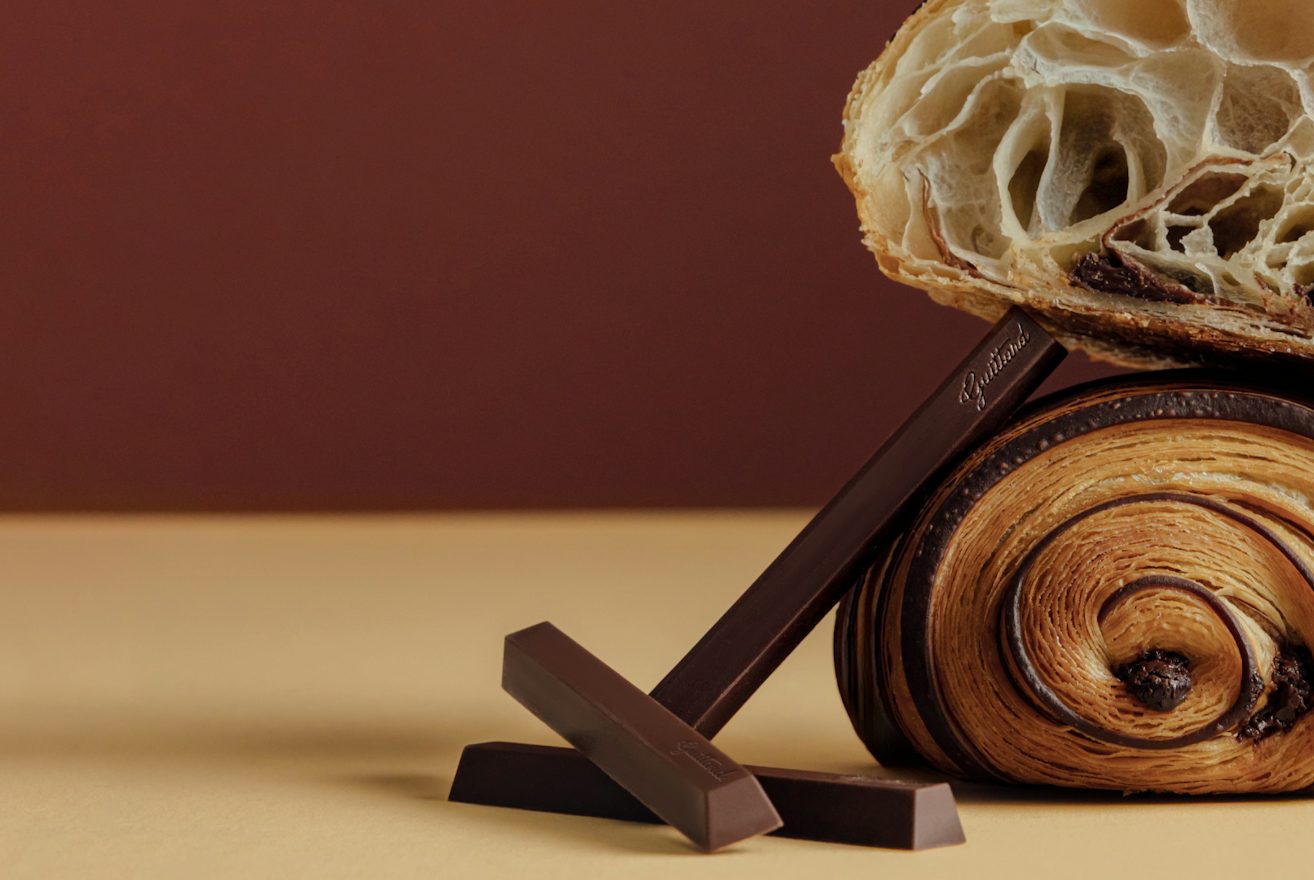
We have something new that we’re pretty excited about. Our Chocolate Batons recently got a refresh -- now 50% dark chocolate and in a new shape, crafted to meet the demands of professional lamination and viennoiserie craftsmanship.
To understand what goes into developing a chocolate baton built for real-world bakery use, Executive Pastry Chef Donald Wressell and Head of R&D Rebecca Kuehn, a couple of the brains behind our updated baton, share a peek into the process behind the final product.
What prompted the baton redesign?
Donald Wressell
We had wanted to make a new baton for a while but lacked the infrastructure to make it happen. A few years ago, we invested in a number of new capabilities in our Fairfield chocolate factory and last spring we installed a new moulding line, providing us with the opportunity to revisit the baton and create a more premium moulded product.
Right off the bat, it was important to us to ask for feedback and input from bakers who worked with our product. Our goal was to keep the elements that were working and make changes to reflect what matters most to today’s professional bakers.
There are already so many chocolate batons out there – how did you make sure you were giving the market something new?
Rebecca Kuehn
It was a lot of iteration. We were testing different formulations, ingredients, but also constantly evaluating how they performed in application.
One of the more interesting parts of the process was comparing batons fresh out of the oven, and then again one hour later, and all the way up to 24 hours later.

Donald Wressell
Fresh out of the oven, most batons are going to taste pretty good. But as time passes, some of them become firm, even a little grainy. We didn’t want ours to do that.
You have to think about how these are actually used. A wholesale bakery might bake early in the morning, deliver to a coffee shop , and then that product sits there for hours before someone buys it. Or they might freeze a pain au chocolat for consumers to bake at home, or to be refreshed at a bake shop.
So what does that experience look like at 2 in the afternoon? Or rebaked after being frozen and shipped? That was a big part of how we evaluated performance.
What were the flavor considerations during the R&D process?
Donald Wressell
There’s a lot of dough in something like a pain au chocolat. You need enough chocolate presence so that when you take a bite, you actually taste it.
We were on the lower end of the cacao spectrum before, and the trend is definitely moving toward higher percentages. People are loving dark chocolate now.
Rebecca Kuehn
We tested a range of cacao percentages—both lower and higher—to find the right balance for flavor and texture.
It’s not just about increasing that number. If you adjust cocoa butter, for example, it might increase the percentage, but it doesn’t necessarily add more chocolate flavor. So every change has to be considered in context.
How did the final shape come together?
Donald Wressell
I started making shapes by hand—literally cutting wooden pieces and testing how they stacked, how they fit in a box, and how they rolled into dough.
The trapezoid was there from the beginning. It just made sense in terms of how the pieces fit together and how they handled.

Rebecca Kuehn
We refined that shape through multiple iterations—more than a dozen. Even small changes in height or angle can affect how they bake, how the batons release from the mould during production, and whether we can maintain target piece weight.
We were targeting a 5.5 gram piece, which is pretty standard, so every design change had to still hit that.

Donald Wressell
There was also a bit of a creative element to it. It loosely resembles a gold bar—a very modernized version, but still a subtle nod to our heritage and gold rush beginnings.
And then there’s also how people use the batons. Some bakers use two, some use three, some use four, so we wanted something that would work across those different approaches. The new trapezoidal shape allows for multiple batons to sit in different configurations next to each other, with ease, within the croissant dough.

And practically speaking, it helps with packing. The shape holds more securely, which helps reduce breakage during shipping.

What defines a successful baton in your view?
Donald Wressell
Flavor comes first. That’s the baseline—if it doesn’t taste good, nothing else matters.
But beyond that, it has to perform in the dough and hold its quality over time. That’s really what we were trying to solve for.
What feedback have you received so far?
Donald Wressell
Initial reactions have been really positive. People notice the flavor right away, and they like the texture.
We’re also seeing chefs use them in different applications, not just traditional pain au chocolat, which is exciting.
Learn more about our new Chocolate Batons and how to try them here.


